Target markets, not a record of completed exports. Import requirements are confirmed per destination.
- MalaysiaSoutheast AsiaASEAN / ATIGA — eligibility to confirm
- SingaporeSoutheast AsiaASEAN / ATIGA — eligibility to confirm
- Timor-LesteSoutheast AsiaDestination requirements to be confirmed
- PhilippinesSoutheast AsiaASEAN / ATIGA — eligibility to confirm
- United Arab EmiratesMiddle EastIndonesia–UAE CEPA — eligibility to confirm
- Saudi Arabia / Qatar / Kuwait / OmanMiddle EastDestination requirements to be confirmed
- Papua New GuineaOceaniaDestination requirements to be confirmed
- BruneiSoutheast AsiaASEAN / ATIGA — eligibility to confirm
- Japan / Korea / TaiwanEast AsiaDestination requirements to be confirmed
- NigeriaWest AfricaDestination requirements to be confirmed
What we export
Our export focus is processed and packaged salt: fine salt sieved to Mesh 16, 18, 20 and 26 (iodized and non-iodized), iodized powder salt K100, and coarse krosok salt sorted into grades K1, K2 and K3. All salt lines are Halal certified. We do not position ourselves as a low-cost source of bulk industrial salt shipped unpacked by the shipload; that is a different market from ours.
Every export order starts from a written specification. Spec values for our SKUs (NaCl, moisture, insoluble matter, and KIO3 for iodized grades) are reported on a certificate of analysis (COA) for each batch. Until the COA is issued we show these values as [COA] rather than quoting typical figures. Grades and sizes are explained on the K1, K2, K3 grades, mesh size and iodine content pages.
Our export buyers are typically food ingredient importers and distributors, food manufacturers, seasoning blenders and fish or seafood processors. They need a defined grade, a fixed pack size and documents that clear customs at destination.
The export process in five steps
- 01
Request for quotation (RFQ)
Send the product and grade, volume per shipment or per month, packaging, destination port, preferred Incoterm and the iodization standard that applies in your country. The export RFQ form collects all of these fields.
- 02
Sample and COA
We send a sample of the agreed SKU with its certificate of analysis. Your own laboratory or a third-party laboratory can test it against your specification before any contract is signed.
- 03
Contract and payment terms
Price basis, Incoterm, quantity tolerance, packaging, the document list and payment terms are fixed in a sales contract or proforma invoice. Payment terms: [awaiting data], agreed per buyer.
- 04
Production, packaging and labelling
The order is produced and packed in the agreed format. Private label packs with your brand and label text are available on request; you approve the artwork and label language before printing.
- 05
Shipping and documents
The goods are loaded into containers at the port of loading ([awaiting data]) and shipped. Original or electronic documents are released according to the agreed payment terms.
Commercial terms
Values marked as awaiting data will be published once the company confirms them. Until then they are agreed per order in the quotation.
- Incoterms
- FOB, CFR or CIF, to be confirmed per order
- Minimum order quantity (MOQ)
- [awaiting data]
- Port of loading
- [awaiting data]
- Production lead time
- [awaiting data]
- Payment terms
- [awaiting data]
- Price
- Quoted per request, not published
Export documents
Documents supplied with each shipment, adjusted to the requirements of the destination country:
- Certificate of analysis (COA) per batch
- Halal certificate (issuing body and certificate number: [awaiting data])
- Certificate of Origin: Form D for ASEAN destinations under ATIGA, or the form required by the applicable trade agreement
- Packing list
- Commercial invoice
- Bill of lading
- Other documents required by the destination country, confirmed before the contract
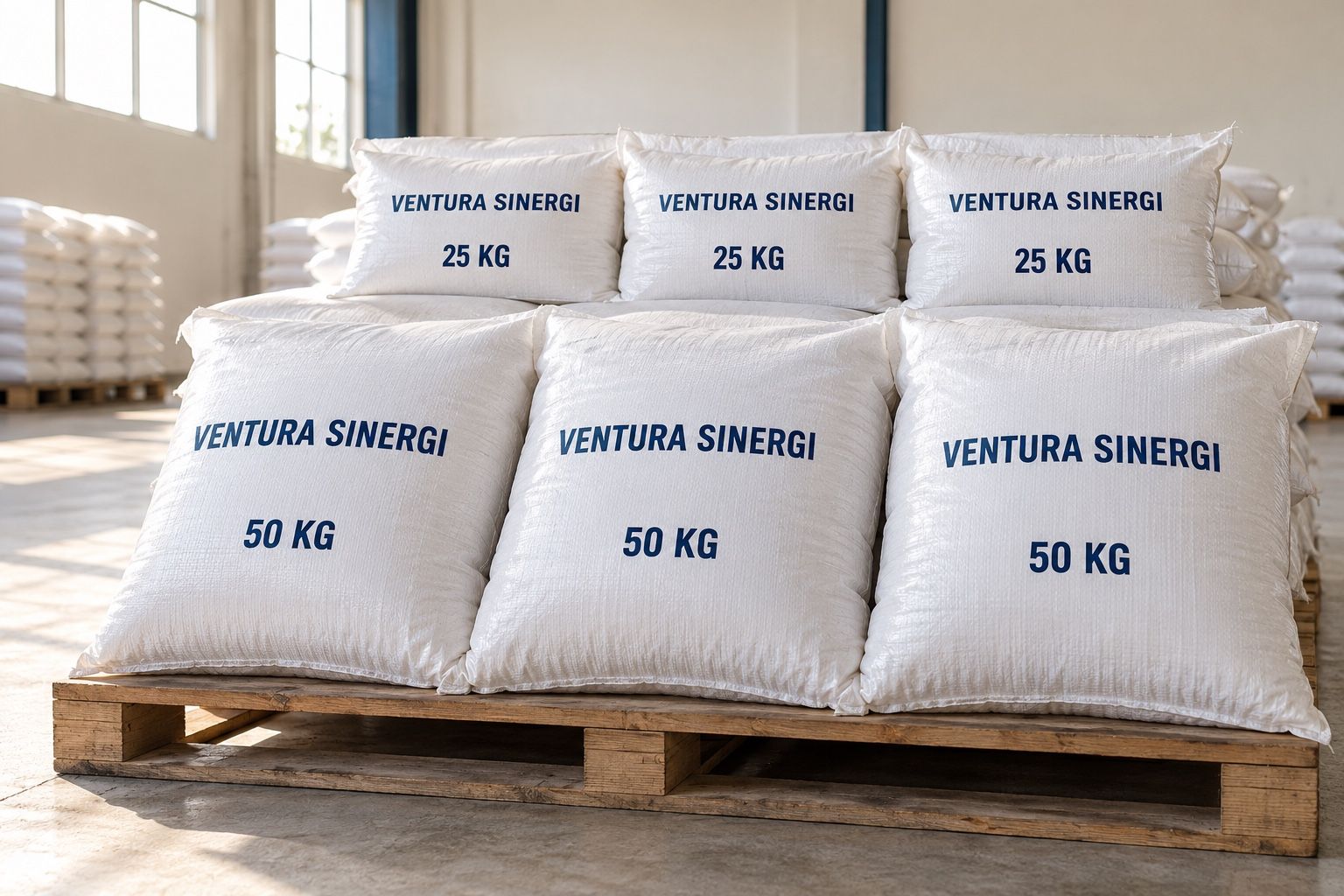
Packaging and container loading
Available formats are 25 kg and 50 kg woven PP sacks and 1-tonne jumbo bags (FIBC); the format is confirmed per order. Inner liners, sack printing and private label packs are agreed in the contract.
How much salt fits in a 20ft container depends on the pack format and on the weight limits that apply at origin and destination. Our salt requirement calculator uses an editable payload assumption of 25 t per 20ft container. That figure is an industry estimate, so confirm it with your forwarder before booking space.
Export guides and country pages
- How to import salt from IndonesiaSeven steps from specification to customs clearance
- HS code 2501 for saltWhat the heading covers and where national codes differ
- Salt export to MalaysiaIodisation rules and Halal
- Salt export to SingaporeFood-grade packaged salt for a trading hub
- Salt export to the UAECEPA and re-export to GCC markets
- Salt requirement calculatorSacks, jumbo bags and containers per month