What K1, K2 and K3 mean
In the Indonesian smallholder salt trade, salt from the evaporation pans is sorted into quality classes K1, K2 and K3. The K stands for kualitas (quality) and the number gives the rank: K1 is the top class, K3 the lowest. The classes are based mainly on sodium chloride (NaCl) content, crystal colour and the amount of soil or other matter picked up during harvest.
K grades are not a parameter of the Indonesian standard SNI 3556:2016. That standard sets measurable limits, such as NaCl of at least 94% on a dry basis and moisture of at most 7% (source). The boundaries between K grades also differ from one literature source to another. Use the grade to start a conversation with a supplier, and use laboratory figures in the purchase contract.
Krosok or gosrok?
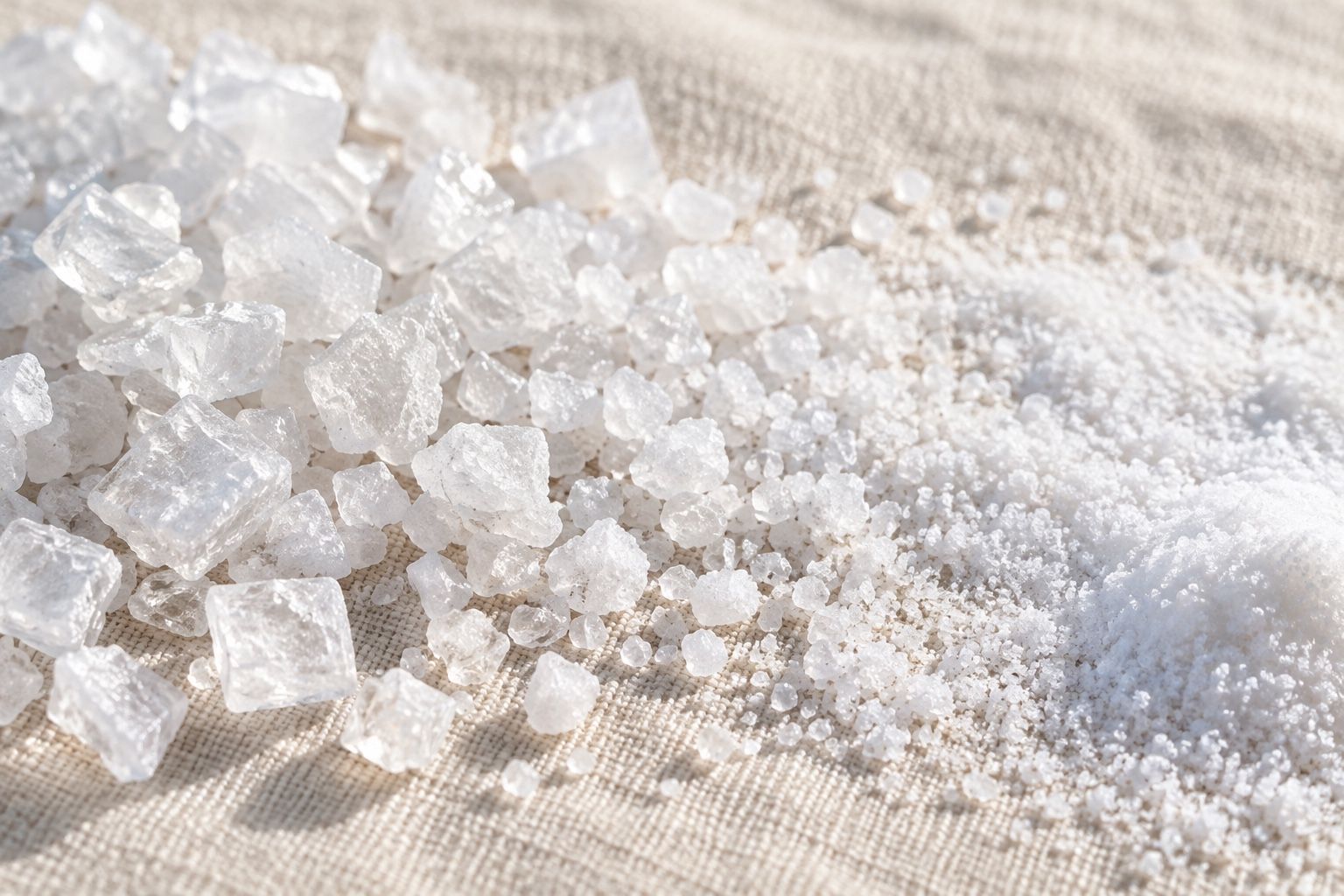
Krosok is coarse crystal salt made by evaporating seawater in salt pans and sold as large grains before it is milled or refined. In some regions the same salt is called gosrok, and buyers also call it garam kasar (coarse salt). All three names refer to the same product.
In search engines, “gosrok” has almost no suggestions of its own and Google corrects it to “krosok”, so this site uses krosok as the main term. Ventura krosok belongs to the non-iodized salt line: all three grades are sold without added iodine. For fine salt sold by particle size, see salt mesh size.
K1, K2 and K3 compared
The NaCl and appearance columns are a general industry description taken from published literature (KKP review), not Ventura product specifications. The last column is filled from Ventura's per-batch COA.
| Grade | NaCl (general industry description) | Appearance (general industry description) | Ventura COA |
|---|---|---|---|
| K1 | At least 94% | White, clean | [COA] |
| K2 | About 90–94% | Between K1 and K3 | [COA] |
| K3 | Below K2 | Duller, greyish | [COA] |
Literature values vary between sources. Product pages: Coarse Salt K1, K2, K3.
Why colour and impurities differ between grades
The grey tone of lower grades usually comes from soil or mud from the floor of the evaporation pan, and from magnesium and calcium salts that crystallise along with the NaCl. These impurities lower the NaCl figure and raise insoluble matter.
Washing removes part of this material. The final COA figures therefore depend on both the raw grade and the processing after harvest. Two lots both sold as K2 can have different NaCl and moisture values, which is why a buyer should look at the batch COA rather than the grade name.
Which grade for which use
Typical selection in the market; confirm against your own process specification.
| Use | Grade usually chosen | Reason |
|---|---|---|
| Fish salting and curing | K1 or K2 | Cleaner salt leaves less dirt on the fish. K2 is chosen when cost matters more. |
| Water-softener regeneration | K1 | Low insoluble matter means less sediment in the brine tank. |
| Animal feed | K2, or non-iodized fine salt | Salt is blended into feed, so particle size and moisture matter more than colour. |
| Chemical, textile and leather industry | K2 or K3, or per specification | Salt is dissolved or used in a process; NaCl and insoluble limits are set by the buyer’s process. |
Typical selection; confirm with your spec.
What to put in your enquiry
Name the grade as a starting point, then add figures that can be tested: minimum NaCl on a dry basis, maximum moisture, maximum insoluble matter, and a particle-size range if your process needs one. With those numbers the supplier can match a batch and issue a COA you can check. Each parameter is explained on the specifications page.
For comparison, SNI 3556:2016 requires at least 94% NaCl on a dry basis for iodized consumption salt (source). That equals the lower bound of K1 in the literature, but the standard applies to iodized consumption salt, not to non-iodized krosok. If you need iodized salt, see iodine content.