How salt works in a water softener
A water softener reduces hardness with a cation-exchange resin. Calcium and magnesium ions in the raw water are exchanged for sodium ions held on the resin. Over time the resin loads up with calcium and magnesium and has to be regenerated: concentrated brine is passed through the bed, sodium displaces the calcium and magnesium, and the rinse water goes to drain.
The brine is made in a salt tank, where solid salt slowly dissolves in water. Anything in the salt that does not dissolve, such as sand or fine silt, stays at the bottom of the tank and has to be cleaned out periodically. Salt with low insoluble matter stretches the cleaning interval and lowers the risk of dirt reaching the injector and valves.
Crystal size matters too. Coarse crystals form an open bed that lets water circulate. Very fine salt tends to pack into a sludge at the bottom of the tank or form a crust above the water line (bridging), so the brine is not saturated and regeneration suffers. That is why coarse krosok is more common than fine salt in brine tanks.
Recommended products
Typical selection for softener regeneration. Confirm against your equipment maker's specification.
| Product | Why it is chosen | Product page |
|---|---|---|
| Coarse salt K1 (non-iodized) | The whitest, cleanest grade in the literature description; lower insoluble matter means less sludge in the brine tank. Coarse crystals keep water circulating. Match the COA values to your equipment maker's limits. | Coarse Salt K1 |
Typical selection; purity must meet the equipment specification. NaCl and insoluble-matter values for each batch are on the COA.
Chemicals for other water treatment steps
Salt is used only for softener regeneration. Other steps use different chemicals, which Ventura also supplies.
| Chemical | Typical role in water treatment | Product page |
|---|---|---|
| PAC (Poly Aluminium Chloride) | Coagulant in drinking-water and wastewater treatment, clumping fine particles before settling and filtration. This happens upstream of the softener. | PAC |
| Hydrochloric acid (HCl) | Regeneration of strong-acid cation resin in demineralisation plants, and pH adjustment. HCl is not used to regenerate an ordinary water softener. | Hydrochloric Acid |
| Caustic soda (NaOH) | pH adjustment, and regeneration of anion resin in demineralisation plants. | Caustic Soda |
Specification, TDS and MSDS on request. NaOH and HCl are corrosive; handle them according to the SDS and local dangerous-goods rules.
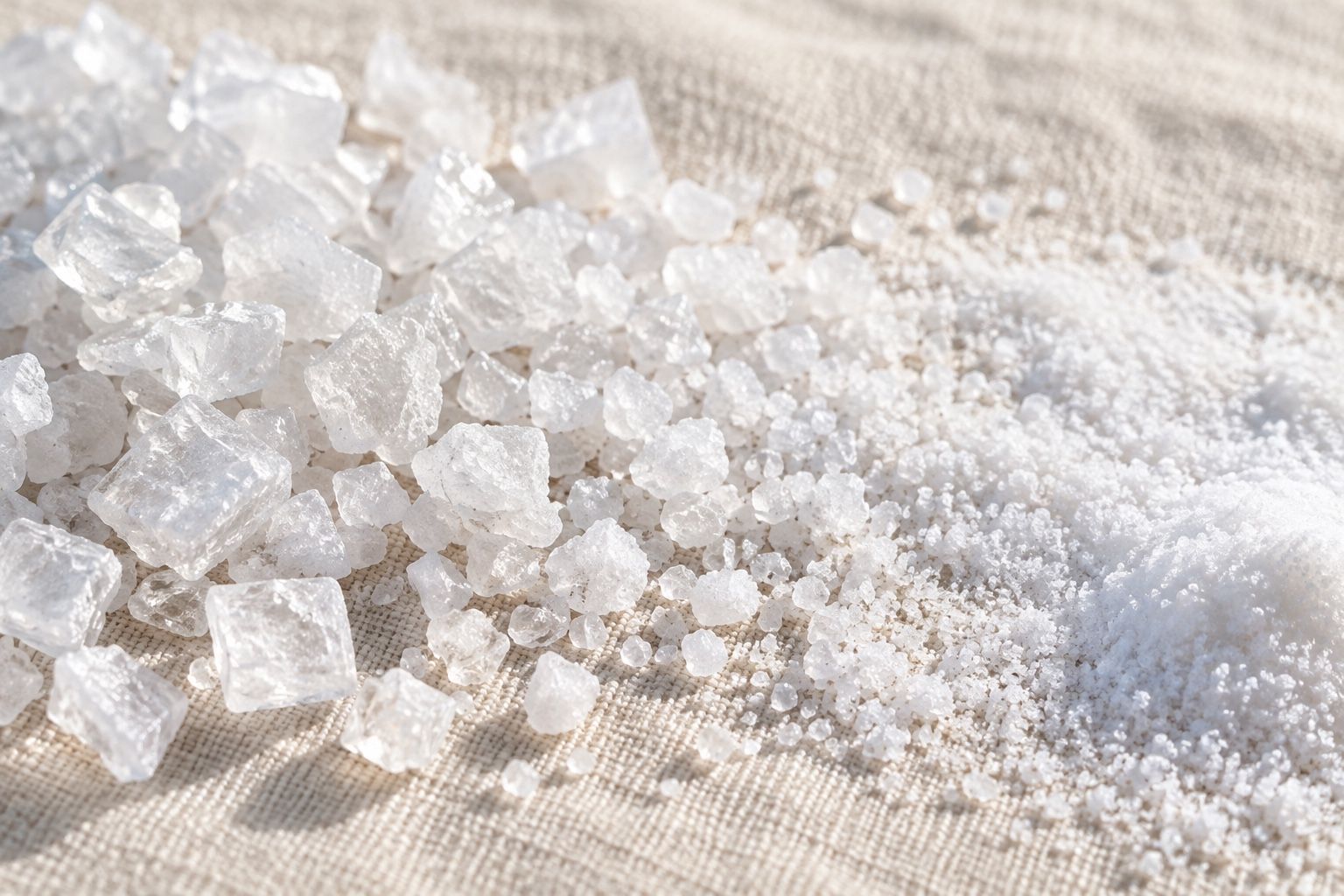
Coarse crystals for the brine tank
Krosok is sea salt harvested from evaporation pans and left unmilled. Its large crystals keep the bed in the brine tank open, whereas fine salt packs down easily.
The differences between K1, K2 and K3 are explained on the salt grades page. For softeners, K2 or K3 are only worth considering if your equipment specification allows higher insoluble matter.
Buying considerations
- Equipment specification: ask your softener or resin supplier for purity limits, such as minimum NaCl and maximum insoluble matter, and match them against the batch COA [COA].
- Iodine: regeneration salt does not need to be iodized, and coarse K1 is non-iodized. Iodization mandates such as Malaysia's since 30 September 2020 (Malaysian Ministry of Health) target consumption salt; for exports, confirm the import classification with your importer.
- Packaging: 25 kg sacks are easier to pour into small and mid-size brine tanks; 50 kg sacks and 1-tonne jumbo bags suit industrial installations. Available formats, confirm per order.
- Documents: COA per batch for salt; SDS/MSDS ships with every chemical. Halal certificate available if the buyer needs it.
- Chemical handling: HCl and NaOH are corrosive to skin and eyes. Follow the SDS and local dangerous-goods rules for storage and use.
Related pages
- Chemicals NaOH, HCl and PAC.
- Salt grades K1, K2, K3 How the coarse grades differ.
- All applications Typical selection for six industries.