Choosing salt by process
Particle size decides how fast salt dissolves and how it mixes. Coarse crystals (krosok) dissolve slowly and form an open bed, which suits gradual salting and brine tanks. Fine salt sieved to a given mesh dissolves quickly and spreads evenly through other dry ingredients, so seasoning plants, bakeries and feed mills use it. Mesh-to-millimetre conversions are on the salt mesh size page.
Purity decides how much foreign matter ends up in the product or the equipment. In the general Indonesian industry description, K1 is the whitest and cleanest grade, K2 sits below it, and K3 is lower and greyer (KKP literature). Ventura publishes its own NaCl, moisture and insoluble-matter values per batch on the COA rather than quoting literature. See salt grades K1, K2, K3 for the full explanation.
Iodization is a regulatory question, not a matter of taste. Several countries require consumption salt to be iodized, while industrial uses such as resin regeneration, or feed formulated with a mineral premix, normally take non-iodized salt. The iodine content page compares the Indonesian, Malaysian and WHO references.
Typical selection by application
Select an application for the process background, or a product for its specification sheet.
| Application | Typical selection | Why |
|---|---|---|
| Fish processing | Coarse K1, Coarse K2 | Coarse crystals dissolve gradually as they draw water out of the flesh; K1 where colour and taste of the finished product matter. |
| Food & seasoning | Fine mesh 20, iodized fine mesh 20, iodized fine mesh 26 | Fine grains blend evenly into dry seasonings and dissolve fast in sauces; iodization per destination law. |
| Bakery & snacks | Fine mesh 20, iodized fine mesh 20, powder K100 | Fine salt dissolves quickly in dough; powder coats snack surfaces evenly. |
| Animal feed | Non-iodized fine mesh 20, Coarse K2 | No added iodine, so the ration's iodine is set by the premix; K2 for lick blocks and bulk use. |
| Water treatment | Coarse K1, purity per equipment specification | Low insoluble matter means less sludge in the brine tank; coarse crystals keep water circulating. |
| Chemical, textile & leather | Coarse K2, Coarse K3 or per specification | Salt is a high-volume process input; the grade follows the plant's raw-material specification. |
Typical selection in industry. Always confirm against your own raw-material specification and a sample test.
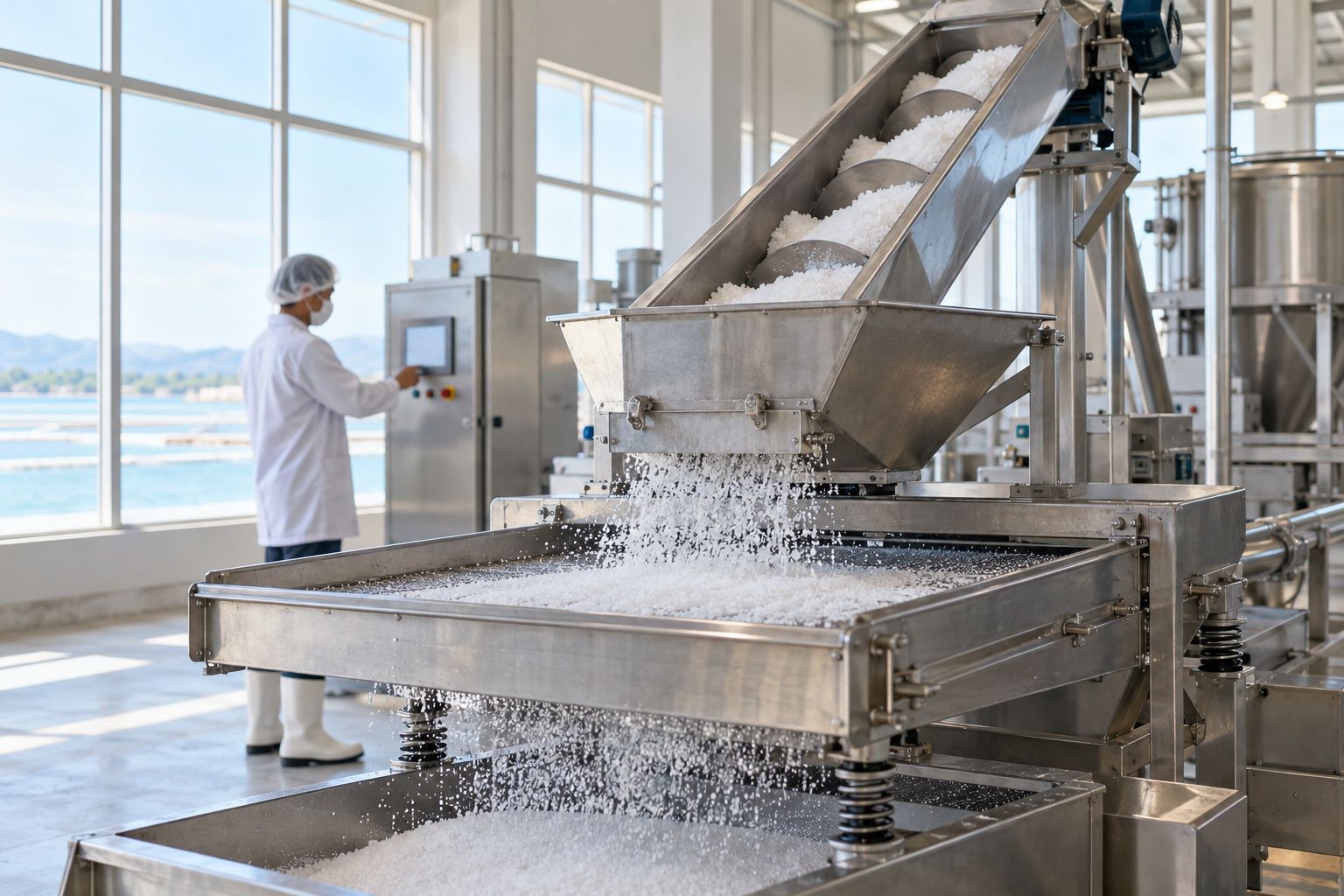
From coarse krosok to fine salt
Sea salt is harvested from evaporation pans as coarse crystals. In this form Indonesian buyers call it krosok, or gosrok in some regions. Fine salt is made from krosok by washing, drying, milling and sieving to the requested mesh. Iodized salt receives KIO3 during processing.
One raw material therefore yields several products with different jobs. Ventura's non-iodized line covers coarse K1, K2, K3 and fine salt mesh 16, 18, 20; the iodized line covers iodized fine salt mesh 16, 18, 20, 26 and powder K100. The full list is in the product catalogue.
What to include in a quote request
- Application and process, for example dry salting of fish, a powdered seasoning blend or softener regeneration.
- The grade or mesh you use today, and the specification limits set by your QC team or equipment maker.
- Iodine requirement: iodized or non-iodized, and the destination standard if the product is exported.
- Packaging: 25 kg or 50 kg woven PP sacks, or 1-tonne jumbo bags. Available formats, confirm per order.
- Volume per month or per shipment. The salt requirement calculator helps if you are not sure.
- Documents you need, such as a COA per batch and the Halal certificate.
Products and specifications
- Product catalogue All non-iodized and iodized salt SKUs, plus chemicals.
- Specifications Grades, mesh and iodine content in one place.
- Salt grades K1, K2, K3 How the coarse grades differ in the literature.
- Salt mesh size Mesh to millimetre table.
- Iodine content SNI, Malaysia and WHO compared.