Why salt matters in dough and snacks
In bread dough, salt tightens the gluten network so the dough holds up better during kneading and proofing, and it slows yeast activity so fermentation is easier to control. It also builds flavour; bread made without salt tastes flat even when every other ingredient is the same. Because the dose is small relative to flour, salt has to dissolve and spread evenly so that no part of the dough ends up too salty.
Fine salt dissolves faster in dough water than coarse crystals. With short mixing times, undissolved grains can leave salty spots. For biscuits and crackers, salt is also sprinkled on the surface before baking, and here grain size affects how the product looks.
On fried snacks such as chips, nuts and crackers, salt goes on with the seasoning after frying. Very fine grains stick better to an oily surface and spread evenly in the seasoning drum, so taste is more consistent from pack to pack and less salt ends up at the bottom of the bag.
Recommended products
Typical selection for bakeries and snack plants. Confirm against your specification.
| Product | Why it is chosen | Product page |
|---|---|---|
| Fine salt mesh 16 / 18 / 20 (non-iodized) | For bread, cake and biscuit dough when the recipe or market does not call for iodized salt. Mesh 20 has the smallest grain of the three. | Mesh 16, Mesh 18, Mesh 20 |
| Iodized fine salt mesh 16 / 18 / 20 / 26 | For products sold in markets that require iodized consumption salt. | Mesh 16, Mesh 18, Mesh 20, Mesh 26 |
| Powder salt K100 (iodized) | For topical snack seasoning and blends that need a very fine grain to coat evenly. | Iodized Powder Salt K100 |
Typical selection; confirm against your specification. K100 particle size and per-batch values are on the COA.
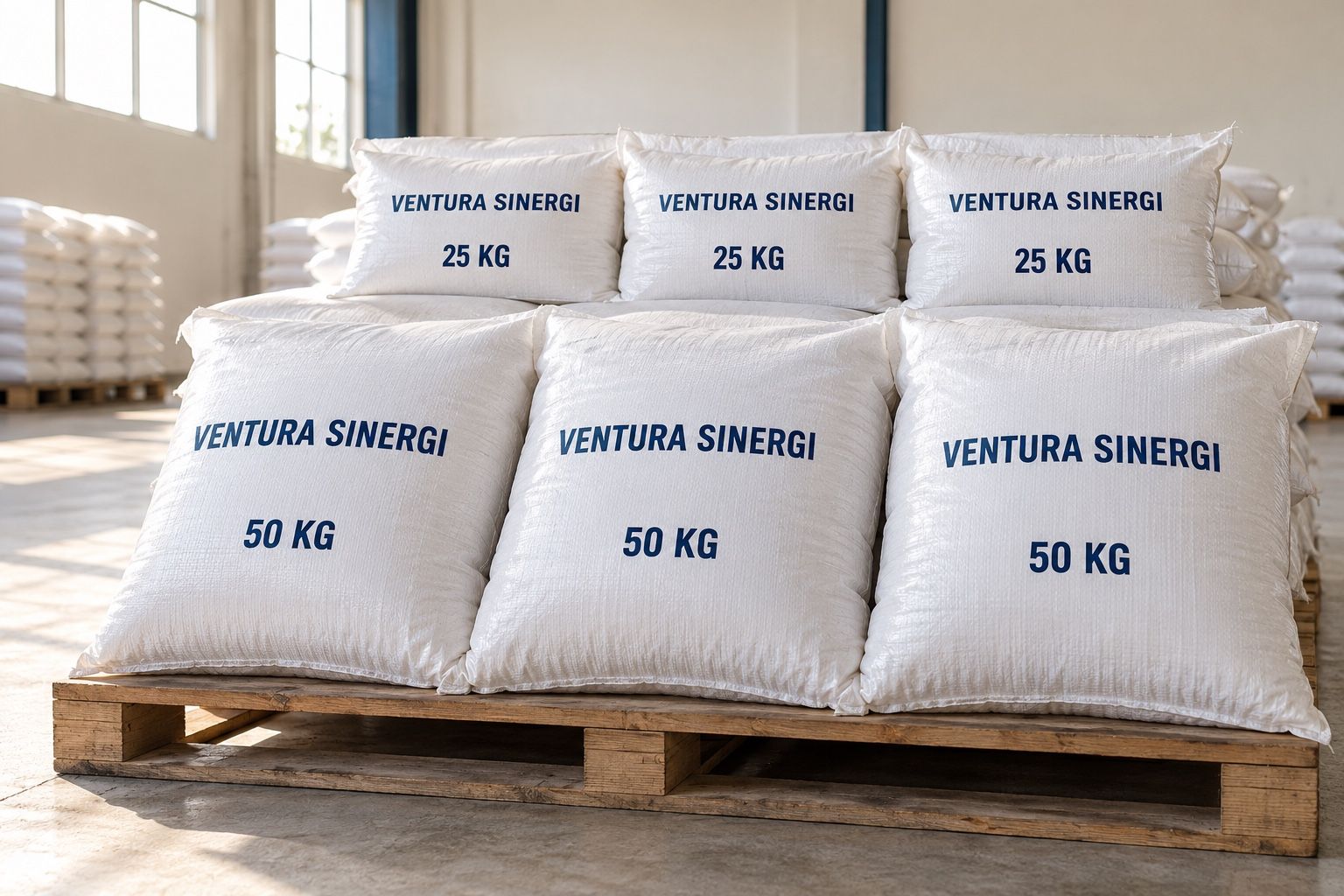
Packaging for bakeries and snack plants
Fine and powdered salt are available in 25 kg and 50 kg woven PP sacks, and in 1-tonne jumbo bags for plants with a silo or bulk dosing system. Available formats, confirm per order.
25 kg sacks are easier for an operator to tip straight into a mixer; jumbo bags suit plants with a hoist or bag-discharge station. Powdered salt cakes more easily in humid conditions, so store it dry and use it first in, first out.
Buying considerations
- Iodization: Malaysia has required iodized consumption salt since 30 September 2020, in the range of 20–40 mg/kg (Malaysian Ministry of Health). In Indonesia, SNI 3556:2016 sets KIO3 at a minimum of 30 mg/kg for iodized consumption salt (source). For other markets, confirm with your importer.
- Labelling: if your pack declares iodized salt, make sure the salt's COA states the KIO3 content.
- Packaging: 25 kg, 50 kg or 1-tonne jumbo bags. Available formats, confirm per order.
- Documents: COA per batch and Halal certificate (certificate number [awaiting data]). See quality & Halal.
- Volume: work out monthly need from output and recipe salt percentage with the salt requirement calculator.
Related pages
- Salt mesh size Mesh to millimetre table.
- Iodized salt Iodized fine salt and powder K100.
- Non-iodized salt Fine salt mesh 16, 18, 20.
- All applications Typical selection for six industries.