What the mesh number means
Mesh numbers come from woven wire sieves. Mesh 20 means 20 openings along one inch (25.4 mm) of the weave. The higher the mesh number, the tighter the weave and the smaller the openings, so the salt that passes through is finer.
The opening is not simply 25.4 mm divided by the mesh number, because wire takes up part of each interval. For Mesh 20, 25.4 ÷ 20 = 1.27 mm, yet the standard opening is 0.841 mm. Mesh-to-mm conversion is therefore read from the table of a specific sieve series, not calculated.
How sieves are used for salt
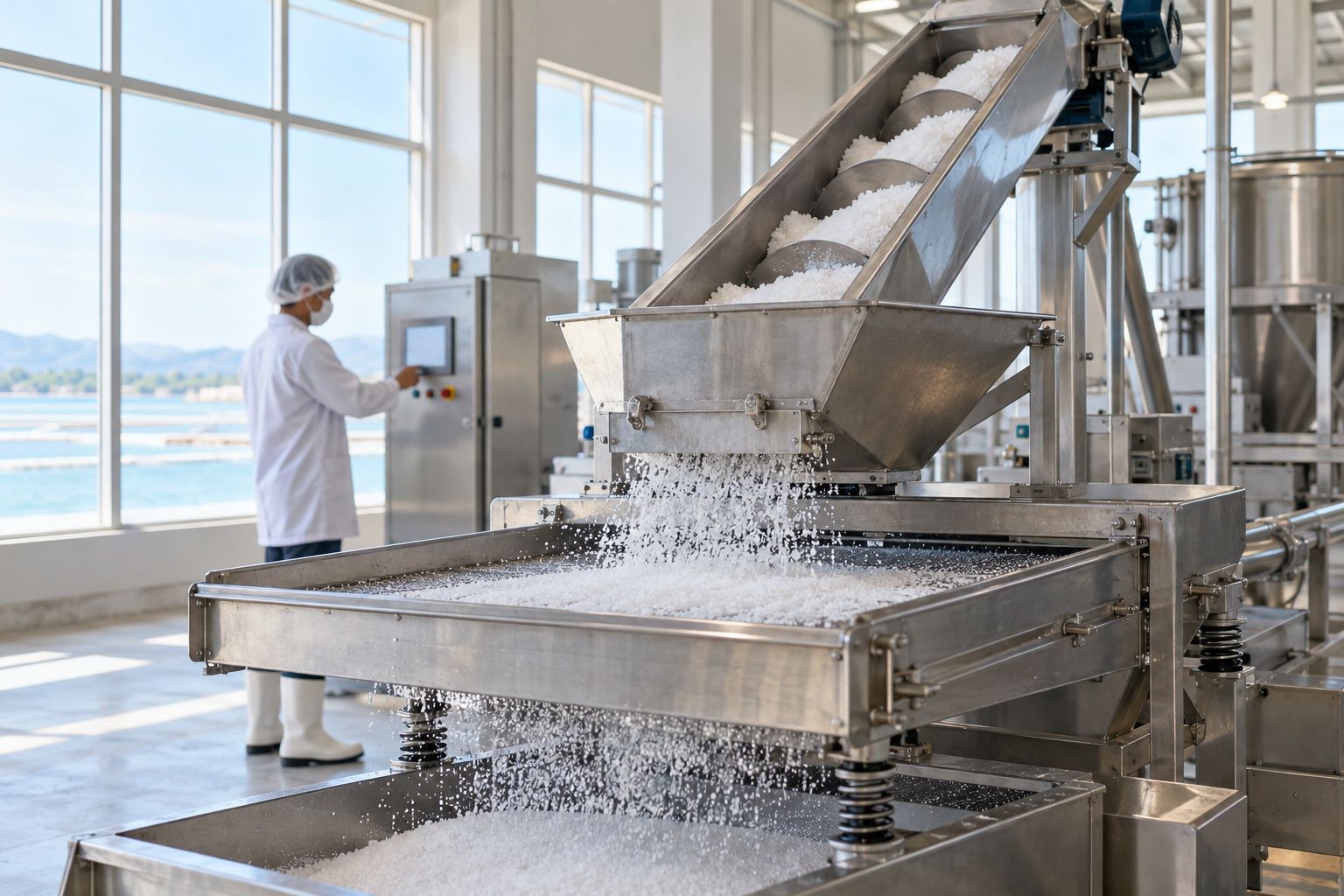
On a fine-salt line, milled salt runs over a stack of sieves. Particles that pass the upper sieve and are retained on the lower one form one size fraction. Salt sold as “Mesh 20” usually means most of it passes a Mesh 20 sieve, but the exact definition differs between suppliers.
Salt is never perfectly uniform. Its behaviour on your line depends on the particle size distribution, including how much fine dust it carries, so a single mesh number on the bag is only a starting point.
Mesh to millimetre conversion table
Values are openings on the US standard sieve series. The last column shows Ventura products at each size.
| Mesh | Opening (mm) | Opening (µm) | Ventura products |
|---|---|---|---|
| 16 | 1.19 | 1190 | Fine, iodized |
| 18 | 1.00 | 1000 | Fine, iodized |
| 20 | 0.841 | 841 | Fine, iodized |
| 25 | 0.707 | 707 | None |
| 26 (not a US standard number) | [awaiting data] | [awaiting data] | Iodized |
| 30 | 0.595 | 595 | None |
Source: Wikipedia, Mesh (scale). µm values are our own conversion of the mm values.
Different sizes. Defined specifications.
Choose a mesh to compare sieve apertures. These are sieve references, not a product particle-size test result.
View specificationsWhy Mesh 26 needs clarification
Neither the US standard nor the Tyler sieve series has a number 26; the standard numbers on either side are 25 (0.707 mm) and 30 (0.595 mm). A “Mesh 26” label may come from another sieve standard or from internal naming, so its size cannot be read from the table above.
We are confirming the sieve used for our Mesh 26 product and will publish its opening once production data is available ([awaiting data]). If you need a tight size limit, state it in mm or µm on your enquiry, not as a mesh number alone.
How particle size affects food processing
Dissolving. Fine particles have more surface area per gram, so they dissolve faster in water, dough or sauce. Coarse crystals can remain as noticeable grains if mixing time is short.
Dosing. Many lines meter salt by volume. If the size distribution shifts between lots, bulk density shifts with it, and the weight delivered per dose changes even though the machine setting has not.
Flow and caking. Coarser, more uniform grains generally flow more freely from a hopper. Very fine salt has more contact points between particles, bridges more easily in chutes and cakes sooner when it picks up moisture.
Dry blending. In seasoning blends and premixes, salt much larger or smaller than the other ingredients tends to segregate during transport. A mesh close to the size of the other ingredients reduces this.
Choosing a mesh by application
Typical selections; confirm them with your specification and a line trial.
- Topping, snacks and bread surfaces: finer grains such as Mesh 20, Mesh 26 or K100 powder salt spread and adhere more evenly. See bakery and snacks.
- Doughs, sauces and processed seasonings: Mesh 20 or Mesh 26 dissolves quickly; choose iodized or non-iodized according to the rules of the destination market. See food manufacturing and seasoning.
- Dissolving into brine: a coarser grain such as Mesh 16 works when tank residence time is long enough.
- Feed premix: non-iodized fine salt with a size close to the other premix ingredients. See animal feed.
What to ask a supplier
- Which sieve standard is used (US standard, Tyler, ISO or an in-house sieve) and the opening in millimetres.
- How “Mesh X” is defined in the specification: minimum percentage passing that sieve and maximum percentage retained.
- A limit on fines, if your line is sensitive to dust or caking.
- A COA per batch showing the sieve analysis alongside NaCl, moisture and insoluble matter.
- A production-lot sample to trial before a volume contract.
Ventura fine salt products
Ventura supplies non-iodized fine salt in Mesh 16, 18 and 20, iodized fine salt in Mesh 16, 18, 20 and 26, and K100 iodized powder salt. Each batch’s sieve analysis will be on the COA ([COA]).
The salt mesh size page has a short version of the table. Send your particle-size specification through the quotation form.