Where the K-grades come from
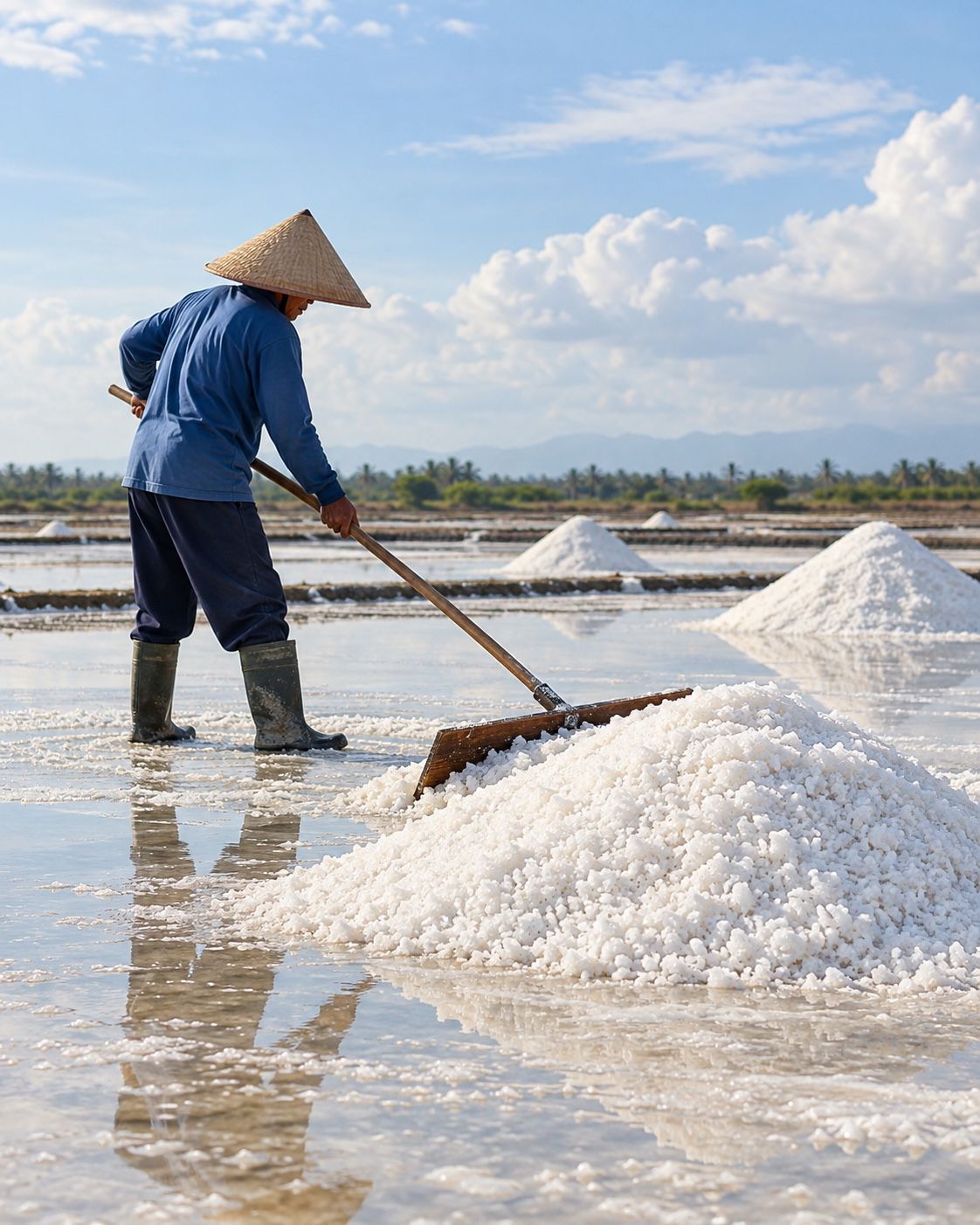
Most Indonesian sea salt from small producers is made by evaporating seawater in shallow pans under the sun, then raking up the crystals that form. Collectors and traders sort each harvest by colour and cleanliness, and that sorting sets the price. The labels K1, K2 and K3 come from this practice.
K1 is the top class, with white, clean crystals and the highest NaCl content. K2 is a step below, and K3 is the lowest, duller and carrying more impurities. Numeric ranges differ between sources and regions, so a grade name should not be the only line in a purchase specification.
Krosok and gosrok: two names for coarse salt
“Krosok” is the Indonesian term for coarse pan salt: whole crystals that have not been milled into fine salt. “Gosrok” is used as a synonym by some traders and in some regions; both refer to the same product. In Ventura’s catalogue, krosok is available as K1, K2 and K3, all in the non-iodized line.
Fine salt is usually specified by particle size rather than by K-grade. That is covered in the salt mesh size chart.
How grade relates to washing and processing
Krosok quality is largely set in the pan. Pan-floor cleanliness, brine concentration at crystallisation and harvesting method affect how much mud, sand, and magnesium and calcium compounds end up in the salt.
After harvest, salt can be washed with saturated brine to remove impurities clinging to the crystal surface, then drained or dried. Washing can raise NaCl content and improve colour, but the result still depends on the starting material. For consumption salt, krosok is usually processed further, including milling, sieving and iodization, before it is tested against standards such as Indonesia’s SNI 3556:2016, which requires NaCl of at least 94% on a dry basis (UNNES IJCS).
K1, K2 and K3 compared
The NaCl and appearance columns are a general industry description from the literature. Ventura’s values are published per batch on the COA.
| Grade | NaCl (literature) | Typical appearance | Typical uses | Ventura COA |
|---|---|---|---|---|
| K1 | ≥ 94% | White and clean | Fish curing, water-softener regeneration, raw material for refined salt | [COA] |
| K2 | ≈ 90–94% | Between K1 and K3 | Fish curing, chemical, textile and leather industries | [COA] |
| K3 | Below K2 | Greyer or duller, more impurities | Industrial uses that tolerate impurities, per specification | [COA] |
Literature source: Indonesian Ministry of Marine Affairs and Fisheries journal. The uses column shows typical selections; confirm against your own specification.
Which grade for which application
These are typical market selections; confirm against your process specification.
- Fish salting and curing: K1 or K2. Fewer impurities mean less staining on the fish, and lower magnesium content means less bitterness. See fish processing.
- Water-softener resin regeneration: K1. Insoluble matter settles in the brine tank and can block lines, so purity matters more than the price difference. See water treatment.
- Chemical, textile and leather tanning: K2 or K3, or as your process specification requires. See chemical, textile and leather.
- Processed food subject to consumption-salt standards: krosok serves as raw material that is refined and iodized first. For finished product, see iodized salt.
Why the COA matters more than the grade name
Two bags labelled K1 from different suppliers can differ in NaCl, moisture and insoluble matter, and harvests change with the season. The certificate of analysis (COA) per batch shows the quality of the lot you actually receive.
A salt COA usually reports NaCl on a dry basis, moisture and insoluble matter; for consumption salt it also covers KIO3 and heavy metals. Compare the COA with your contract limits on arrival and keep a retained sample from every lot. Information on Ventura’s quality documents is on the quality and Halal page.
What to specify in an RFQ
- The grade (K1, K2 or K3) together with numeric limits: minimum NaCl on a dry basis, maximum moisture and maximum insoluble matter.
- Crystal size, if it matters to your process, written as a range in mm.
- Packaging: 25 kg sacks, 50 kg sacks or 1-tonne jumbo bags (available formats, confirm per order).
- Volume per month or per shipment, schedule, and destination city or port.
- Documents required: COA per batch, Halal certificate, and export documents where applicable.
A one-table summary is on the K1, K2, K3 grades page. Send your specification through the quotation form, or browse the non-iodized salt range.